Showing posts with label Conneaut Lake. Show all posts

America The Beautiful - A Time Of Memories

The Anderson Kids - Photo Of My Uncles & 2 Aunts  - Taken About 1907

Sitting, Left To Right: Wes, Elizabeth (Bid), Bob
Standing, Left To Right: Avery, Arie, Hazel
Click Image To Enlarge

The short stories of growing up in America in this blog are all true.  Some of the names, and exact places may have been eliminated or shortened to respect privacy.
In addition to this blog, I hope you will use the links in the left column to visit my other web sites and blogs.


You can contact me by leaving a comment with your email. I will not make the email viewable by the public.  If your message requests a reply, please understand that it may take some weeks or even months before I or one of the folks helping me replies or responds (as my health is failing rapidly now). * 
If expecting a reply please be sure to check your spam/junk mail filter as some have reported the email reply ends up there.
 
Hope you enjoy the stories and memories....


Dave
Photo: Anderson Uncles and Aunts about 1907 at Conneaut Lake, Pa. (East side lakefront near Shady Avenue). Using the photo above as a guide, can you name them? Back row left to right: Hazel, Wes, Elizabeth (Bid) Middle left to right: Arie, Ave Front: Bob

American Family Heritage

http://www.mundia.com/ca/Person/62028547/44079572179Granddad 1906 at Conneaut Lake

He was born in Lancaster, Keokuk County, Iowa in 1872.


He was my Granddad, my friend, my mentor, and with Grandma, they were the most important people'http://www.mundia.com/ca/Person/62028547/44079572179' in my life. 

Grandma hugged a lot but she
didn't say too much, instead setting an example of how a grandma should be. 

Granddad didn't hug as much but had a lot of incredibly important things to say and even more to teach his grandchildren.

In a quiet, respectful, loving and very special way, they taught me about life, about our country, about our wonderful world. Most importantly, they taught something intangible called values and honor and respect and dignity. And they taught me the incredible values of religion.

Among other things, Granddad showed me (and many of his 39 other grand kids) how to plant corn and prune an apple tree or even pluck chicken feathers.  How to shoot, hunt and fish, tend a garden, scythe a field and hundreds of related skills. 

And perhaps more importantly, how to work, how to pray, and the importance of family and respect for others. Grandma, how to hug, love, care, cry and many ways of life.

When with Granddad or Grandma, I was showered in respect, dignity, courage, love and all the other great attributes they had learned growing up in Iowa, visiting family in Trinidad Colorado and then finally moving east around 1895.

Granddad was a self educated, self made, serenely quiet man.  In his city house he had over 1000 books in his library, and they were not there for show.  He had read them all and could quote many. 


He loved poetry, billiards, hunting, fishing, drawing, flowers, gardening and most of all his wife and family.  He was soft spoken, very stern, but also very warm.  His concepts of responsibility and wisdom and hard work brought him to the world of both financial and personal success. The N.Y. Times described him as a "Pittsburgh Industrialist" but to me he was just Granddad.

Truth is, he didn't seem to be interested in money or financial success, or it least he never showed it.  He usually wore a somewhat wrinkled white cotton shirt like shown in the photo above but skipped the tie when working in his garden or tending his flowers and dozens of fruit trees. 

He taught me practical things like how to sharpen a scythe and tend the garden, trim a mulberry tree and shoot at the blackbirds and crows that raided our corn.  Where else could a city kid like me get an education like that?
And he taught me something called values. Values I’ve cherished and carried with me through a lifetime of over seven decades.

Like Granddad, Grandma was quiet, warm and loving. Most of the time she had one of her Grand kids or Great Grand kids in her arms and her knitting on her lap.  
In my mind I can still see her sitting in her rocking chair on the front porch with the latest grandchild on her lap*.  Enjoying the breeze and overlooking the lake at their summer house with a sparkling glint in her eyes and a graceful, and very soft smile.  If she was not there, she was upstairs sewing on her treadle powered Singer sewing machine.  

An old fashioned woman living an old fashioned good life.  In my entire life, I never heard her complain or say anything bad about anyone or anything.

When I was little I also visited Granddad and Grandma almost every weekend at their "City House" in Ben Avon, Pa.   I'd climb the first flight of stairs past the stained glass windows on the landing and on up to the library.  

Sometimes up another flight of stairs to granddad's billiard room where across from the cue rack and spittoon was a very large play area for kids.

Opposite the door to the billiard room was Uncle Ave's room.  Ave worked  Granddad's factory and wholesale business and had been wounded and badly scarred by mustard gas in world war I.  

Ave was artistic, quiet and shied away from obnoxious people.  Like Granddad he painted beautiful pictures, mostly oils and many in the style and appearance of Frederick Remington.  
 
Shortly after Ave came home from the first World War, his wife took their kids and took off with one of her unscarred boyfriends.  I never heard Ave speak of his family or even acknowledge his family.  The wife took the children and abandoned Ave. 

I met and spoke with Ave’s children, my cousins, in later years but heard no good words and many inappropriate words about their father.  Cousins who really only knew or seemed to remember memories  embedded by a self righteous mother rationalizing some or most of her own behavior.  Although living only a few miles from Granddad’s summer home, tragically those cousins never chose to associate with the rest of the family.  Even though they were invited and even long after Ave’s untimely death. 

But fortunately I did get to share my life and growing up experiences with dozens of other first cousins at Granddad's summer place at Conneaut Lake. 

But today I was still a child standing  in the billiard room where there were large window seats.  And when you lifted the lids of the window seats there were hundreds of children's building blocks and toys galore.  

Giant block towers were waiting to be built and come crashing down, only to be built again in a newer and better way. 

There were exquisitely detailed pen and ink drawings on the wall that Granddad had drawn and some of Ave's western paintings. 

There was a huge blackboard showing diagrams of Willie Hoppe's best angles for 3 cushion billiards.  A blackboard that we grand kids couldn't touch but boxes and boxes of toys that we could, should and did touch and enjoy.  

The fine billiard table and a rack of tweve fine cues meant Granddad took his game of 3 cushion billiards very seriously and the heaps of toys meant that he took his grand kids just as seriously.

In those long winters of my childhood, I spent many a weekend snuggled upstairs in Granddad’s library pouring though almost a thousand books. That was long before TV and there was plenty of time for Granddad's stories and rocking slowly in his giant dark stained mahogany rocking chair.


a.cr-1886
Granddad in July 1899 at a family reunion in Trinidad Colorado.  I looked just like him at a similar age!
Stories of covered wagons and how the Indians had scalped an older relative in Colorado. Of growing up in the years after Abe Lincoln. Of children that had perished when Grandma and Granddad had moved east. 

Of men great and small.  And of their hopes and dreams. 

Of cherishing but not too much.  Of religions and Mose,  Lot and Abraham.  Of Mathew, Mark, Luke and John and Peter and all the rest. 

Of the lessons and philosophies of other major religions and world history.  Archimedes, Socrates and Plato. Science, Philosophy, Poetry and Music. Of John James Audubon, Luther Burbank and Charles Schweitzer.  

Of slowly and patiently turing 4 separate dials on an old floor model crystal radio that had 2 giant tubes and even a speaker.  Of joy, happiness and later sorrow and weeping.  Sadness and tears when a cousin died in the war and silent weeping when Grandma died a few years after the war ended.

I wept too, not just when family or friends died, but when winter weekends (or the summer season) ended and I had to go back to my parents home and the terrible fear and trauma of their sadistic world of abuse and greed, hate and anger. That was a far different world than the peaceful security of my Grandparents home.

In later years I would come to realize that Granddad and Grandma knew the abuse was going on in my parents home and that they both tried to keep me away from my own family as much as possible.  In those days there were no social service agencies. 

And in those days of old, families tried to take care of their own problems.

I grew up to be an engineer, teacher, college professor and a businessman.  And for every day of the more than 75 years I have been here sharing God's good earth, I appreciate more and more the memories and wonderful experiences and philosophies given so gently and gracefully to me by Granddad and Grandma.


So in a way, this short story and this blog are a way of thanking my Grandparents and those wonderful friends and relatives that have stood by me over the years since.  

A very special thanks to those wonderful Grandparents who took time out of their lives for me and 39 other grand kids.

It would take much more than a Blog or even a book to tell all they taught me, all they did for me.

Footnotes:

Pic og granddads city house taken in 2008. << Photo of Granddads city house in Ben Avon as it looks in 2008.

He bought it in 1906 and sold it shortly before his death in 1954.

Not much has changed on the exterior except the back porch was replaced with a newer modern one and some updates to the patio.

In the old days the lot next door was also granddads and had a large gazebo and incredible flower gardens.

A.CR.AdToSellCottage-5-18-1918 When his sons went off to war, Granddad got discouraged and sold off some of his West Side and East Side property at Conneaut Lake. 

The photo to the left is an ad he placed in the Pittsburgh Press in 1918.

Later, living on the west side of the lake, Granddad sold a 100’ of Lakefront beside his dock to the Rockwell family from Meadville, then in about 1949 sold about a half mile of lakefront (now the beginning of Aldina Drive) to some investors who wanted to fill and develop the lakefront.

In about 1953 he sold his summer house, which we called the “big house” overlooking the dock and lake to Art Britton who claimed he wanted it for his crippled daughter.  Art promptly re sold the house to the Wiley family, who years later resold it to Cyril Mead who added the swimming pool where beautiful gardens once stood and my Aunt Katharine and Uncle John Dearing were married .

Of his original 40 acres or so on the west side of the lake, Granddad kept about 18 acres for his heirs.  And they still use some of that land, including the dock with the willow tree he planted in 1938, to this day.

As a teenager Granddad (Cecil Robert Anderson) began working for Martin Hardsocg near Ottumwa Iowa not too far from where he was born.

Later he invested in Martin Hardsocg’s company (the company was named Martin Hardsocg for its original founder in Iowa).   Granddad eventually became Secretary Treasurer of the company and later President and sole owner.

During those years Granddad got many patents and sold some of  them to mining tool manufacturing companies including Martin Hardsocg.

At the bottom of this page are clips from newspapers and other documents mentioning Granddad between 1880 and 1930.  Some of the clips can be clicked for more information.

With many friends help I’ve constructed a family tree and made the family tree public on Ancestry.com.  It now has over 2000 family members and hundreds of photos and as I am able, I try to keep expanding its scope.  

For  family branches such as the Wray family it dates back to about 1050 (England/Wales). 

For privacy however names and photos of living relatives are not shown to the general public but are available to bloodline cousins on written request if they provide their email address to me.

* The last grandchild she rocked in that front porch rocker was cousin Alan Wray.

Breakfast At Grandmas: The War Years 1941 - 1945

Breakfast At Grandma's I stumbled past old Al's room and tripped for a second as I rushed down the back stairs.  Led onward and downwards by what seemed to be elegant rich scents. Scents of heaven.  Breakfast scents pulling me nose first right down those very dark, narrow and somewhat creaky, dark stained and worn oak boards some called steps. 

I stumbled a bit more and landed on the kitchen floor almost knocking old Al the cook off his feet.  I was seven or so and always in a rush. 

No, I didn't have a cook, but my Granddad did and we called him Al.  His real name was Alfred McClelland and old Al was looking at me with a bit of a frown that quickly faded to a glowing Tennessee smile.

Granddad had been as poor as a church mouse when he and Grandma were kids in the 1870's, but he worked very hard and in the America of the late 1800's and early 1900's he had succeeded pretty well.

On this trip to the lake Granddad had left Emma Carpenter and his other maids at his winter house in the city (picture below) but old Al who was in his mid fifties but looked 70, came to the lake every summer back then with Granddad and Grandma.  By then Grandma was in her 70’s and Granddad knew it was too hard for her to fire up the two giant wood cook stoves. 

Al seemed sober today and I couldn't see any bottles of aftershave or whatever Al had been drinking sticking out of his pocket. That peculiar smell of booze didn't seem to be there this now dawning summer day.

With the wonderful aromas and gentle yeast like scents of fresh baked bread and today's breakfast in the air I certainly didn't notice Al’s breath, at least this time.  Al liked his booze but never drank when Granddad was in town.  Granddad spent only a few days a week at the lake and the rest of the time he was in town and his "city place". Working or so I guessed.

I was a kid back then during the War and not supposed to know what booze was and I don't think Grandma ever told Granddad about Al's drinking cause Granddad openly didn’t approve of alcohol except for cuts and as medicine.

Al carefully lifted the burner top on the big kitchen wood cook stove and threw another log into the leaping flames.  There were 2 wood stoves, a smaller green and ivory one on the back porch, and this, the much larger black and silver one, in the kitchen.  It wasn’t too cold that morning so the porch stove hadn’t been fired up. Even in the summer of 1945 that big old wooden cottage could sometimes get quite chilly.

It was summertime and we were living at Granddad's country house overlooking Conneaut Lake in Northwestern Pennsylvania.  Granddad had already come back from fishing that morning, cleaned the fish on the old log down by the chicken coop*, changed his clothes, put on a clean but somewhat wrinkled white shirt, and was standing in the dining room gently reading and tapping the dial of his barometer.

A huge black iron skillet was full of today's catch.  In the oven and warmer on top of the kitchen stove were soft brown rolls and a loaf of very fresh yeast risen bread.   

Al moved the fish to the oven to keep them warm and began frying the ham and bacon, both freshly sliced.  Fresh eggs from the hen house in the apple orchard would soon join the covered rolled oats and pancakes already on the dining room table.

"Son", Al said in his southern accent , "cover them rolls and carry them to the table and fetch some more wood and I'll save a special treat for you. And I do mean special. And by the way... fetch me some well water if you could and chip some ice for your Grandfather."  Granddad wanted his coffee black with just a touch of cream but very hot, and his water very cold. The two ice boxes were on the back porch and there was no electric refrigerator because the Harley D Carpenter power company provided electricity was off about as much as it was on. Instead the ice man brought ice twice every week.

Al called almost everyone who was a kid, son.  Even the younger girl cousins.  He called the men, my uncles and other older cousins, Mister and the lady folks Missus even if they weren't married.  We got the water from a well near the garage about 150 feet from the house.  I had got real sick from that well last year and I hoped Granddad would have a new one dug soon. Granddad had said he would and he always kept his word.

The dining room table was set for only 3 today.  Granddad, Grandma and me.  Some days it would be set for 12 or more and some days the kids like me had to eat in the kitchen when there were too many adults (or always when we were at Granddad's city house where all children, until they were 10 ate in the kitchen).  In the summer at his cottage, which we called the big house, Granddad seemed more relaxed.   He bent the rules and we were welcome in the dining room and just about every where else. 

By then Granddad owned about 40 acres of land adjoining his house. Years later when he was much older, folks conned him out of much of the waterfront and even the house we were sitting in.  But those days weren't here yet and we enjoyed every moment at the lake.

grandmaa Picture of Grandma Anderson when she was about 26 in 1899.

Grandma gave me a hug, then sat down. Then Granddad sat down, then me. It was a ritual, no one sat down till Grandma did.

The sun had just come up fully and the light bounced off the lake and then off the mirror and into my eyes. Grandma saw me squinting and said I must need glasses.

There was new flypaper hanging from the chandelier above the table but no bugs were stuck to it.  The faint sound of a small outboard motor down on the lake and the much louder sounds of morning doves, and of birds everywhere chirping and singing were familiar and reassuring.

Unlike in the city, there were no air raid sirens out here in the country and  Grandma's canaries in the two cages by the dining room windows sang all day long every day. 

Back in those days, before the invention of modern bug sprays, there were 100's and even thousands of birds everywhere.  I knew cause in years to come I would be the one chasing the crows and blackbirds from our cornfield or the Starlings from the birdhouse Granddad had built for the Purple Martins. 

The world was alive and living and I had heard of John James Audubon and viewed the beautiful bird pictures in his books long before I was 5 years old.

There was no TV playing that summer morning cause TV's weren't in use yet and World War II was still on.  When we were sitting at the table there were always conversations and many were about the war.
 
About everything new.  And rememberibg cousin Freddie being sent to the Pacific to bomb the Japs and not buzzing the cottage every afternoon in his B17 (which he usually did during Granddad's nap time). There was one talking rule though.  If you complained or spoke badly at the table, you had to get up and leave.  Grandma said meals were meant by God to be happy times.  Unhappy talk was never allowed.

In the evenings, we'd strain to listen above the static to the ancient Philco radio in the sun room.  We'd hear the news or Fibber Magee & Molly or maybe put a roll in the player piano which seemed to break a lot.  The phonograph was a crank up job and I wasn't allowed to play with it or even crank it up.   I think I and my cousins may have cranked it to tight too many times.

Grandad's City house (Photo 2008 but it hasn't changed much) Photo: Granddad’s city house as it appeared in 2009, basically unchanged from the way I remember it in the mid 1900’s..
But I never ever saw my cousin Freddie again or felt the house shake when he flew low over it.  His plane had crashed somewhere in the Pacific near or over China after a bomb run over Japan the previous winter.  Freddie and his enthusiasm and laughter would be gone forever, but living eternally in our memories.

It was early morning now though and there seemed enough food for 10 people.  Granddad raised his own chickens, with a chicken coop, house and pen and the fish, fresh from the lake, were as fresh as the eggs. Granddad got up just about every morning at 4:30 or so and went fishing.  Once in a great while, if I had been very very good, I would be asked to join him.  And that was a very special honor.

If you've never eaten real fresh food, freshly cooked on a wood stove, you've missed something very rich in much more than aroma flavor and taste.

Granddad said grace which he did at every meal, then we all dug in.  I don't know how many calories I ate (or for that matter Granddad and Grandma ate) for breakfast in those days but it must have been a huge number for all of us.  I was thin though, maybe because I got to earn a little extra money by working outside all morning then playing hard all afternoon. Granddad too was very thin too but Grandma, well, she was more on the slightly plump side.

The cholesterol count would have been so high a modern MD would pass out.  But the food was freshly grown or caught, natural, no additives. Zero, ziltch. .  We ate real butter, real milk, real cream and real everything. We raised our own potatoes, corn, beans, peas, lettuce, carrots and most everything else from apple's to grapes.  We lived a real life.  There was no plastic, no oleo, no trans fats, and little or no junk food.  Most of the things we eat today hadn't been invented or if they had no one would have chosen to eat them!

Grandparents7-1924
Photo: Grandma & Granddad July 1924 age 51 or so.
I miss those days.  I miss Granddad and Grandma and old Al and the fineness and wafting scents and sounds of a world long gone but still incredibly alive and vivid in my mind.  A world where folks had time to have a real breakfast and time to hug and enjoy their emotions and the great and wonderful gifts of nature.

Where the smells and sounds of cooking filled the house with hunger and anticipation and old Al's recipes meant food fit for the Gods.  And believe or not, there were lots of kids who were blessed with down to earth Grandparents like mine.

In my mind I have thousands and thousands of hidden memories waiting to be rediscovered and in a way, relived as stories told and remembered, like this one. 

I can somehow smell the scent of the fresh country morning air after a night so clear the the Northern Lights glimmered and danced all night above the horizon.  And most every night back then the sky was filled with sparkling, brilliant stars and a shining moon so brilliant that it almost hurt your eyes. There was very little if any pollution a hundred miles from the cities.  The air was clean and you felt good. Really good.

I can close my eyes and see Grandma sitting on the front porch in her white wooden rocking chair with one of the Grand kids dozing in her arms and her knitting resting on her lap.

In my mind I can still see Granddad walking up from the boathouse with a stringer of fresh perch and grinning from ear to ear.

If I can listen very carefully I somehow think I hear my Grandparents speaking very softly in my ear as they both did when they put loving arms around me so many times. 

To offer reassurance and dignity and guide not just me but all of their grandchildren gently and surely toward this great adventure and challenging journey we call life.  

*Footnote:  A few summers after Granddad’s death, the large log down by the chicken coop, that he had cleaned many a fish on, vanished.  For those of us that cared enough to notice, it was a big and unsolved mystery and the talk of summers to come. 

In 1986 I attended a Thanksgiving dinner at my Aunt Gady’s house in Palm Harbor, Florida.  Cousin Nancy Anderson Means (see her photo below), also attended.  After dinner, Nancy pulled me aside and confided in me that it was she who took the log, noting it gave her a good feeling and good memories of our Grandparents and that she still had it.  She related to me how, as a small child, she’d stand in the orchard watching Granddad clean the fish. noting that from time to time, he’d let her help.  And one day standing there next to the log, not long after her mom died when she was about 10, he had held her in his arms to comfort her grief.

How many grandkids would save a 20lb log and then haul it all the way to Florida? 

That’s how much our grandparents meant to all of us. Nancy’s gone now.  I feel in my heart that she’s with Grandma and Granddad.

* Note: The 1940 U.S. Census lists old Al as a live in member of Granddads household. Al had his own room at the Conneaut house but in Ben Avon lived in the servants quarters above the garage (photo below of granddads garage with living quarters above. As it appears in 2010) at granddads city home in Ben Avon.


Photo: Cousin Nancy Anderson Means on her wedding day a few years after granddad's death.

Granddad A's Summer Place


Photo Granddads cottage as it looks today, almost exactly as I remember it.

Let me try to describe the rich experience of a very special childhood growing up on the west side of Conneaut Lake in Northwest Pennsylvania during the war years of 1938 and beyond.

We called Granddad's summer house, 'the Big house' cause next to it, granddad had a smaller cottage for family which we called 'the Little house'. 

Life back then was in many ways similar to that depicted in Little House on The Prairie. 

Granddad had been born in Iowa in 1872, so his values and way of life were the much like those of the Engle family depicted on the Little House TV show.

Originally Granddad had purchased a lakefront cottage near Shady Avenue on the east side of Conneaut Lake in about 1905, but that cottage burned down in about 1915. Granddad looked and found property on the west side of the lake just north of what is now fireman's beach that was owned by Arthur Clarke Huidekoper. 

That property had previously included a rather ugly looking home overlooking the lake. The house at the time was sitting on the east side of 2nd street on the ridge above the lake near where the railroad tracks eventually came.
Photo of house about 1890:
Nearby were remnants of Huidekopers horse farm and stables including an indoor racetrack.
See photo: Just to the right of the then red house, 2nd St turns into Aldina drive.
. Granddad moved the house back about 200 feet to the west side of 2nd street and raised the elevation about 4 feet, then remodeled the exterior slightly to dress it up and painted it white. 

He planted elm trees along 2nd street and built a sandstone wall along the front next to the street.

Nearly 100 years later one of these trees came crashing down.

 Photo of Granddad's summer house and fallen tree 60 years after he sold the house and about 92 years after he planted the trees along 2nd St. :


Behind the house was a tailored lawn and flower gardens and tool house. Behind that Granddads large vegetable garden and corn field,  chicken coop, 27 tree apple orchard, uncle Wes's house and finally what became our cottage but at the time it was a horse stable for Bill, our horse. 

Behind the stable was a tennis court. Behind the tennis court were acres and acres of woods interspersed with open fields, a creek, a small swamp and a much larger swamp.

In the first 300 or 400 or so yards of the woods (heading west) he planted evenly spaced scotch pines about 75 feet apart. A single train track eventually formed the east and north borders of granddad's non lakefront woods and property. (The train track was removed in the 1960's).

Twice a day the train came. Once heading north, the other south. A loud growling churn and synchopated rhythm of the great wheel drive sounded from the old steam engine. The whistle would sound louder and louder, a deep rumble shook the ground and our ear drums as we ran to wave at the conductor, fireman and brakeman.

Old_TrainMy cousins and I loved to watch the trains go by. We counted all the cars and wondered with all the roar, soot, smoke and cinders why some of the older box cars or maybe our woods didn't catch on fire. 

Hidden near the middle of the woods behind the giant yellow pines granddad had planted on the west side of our property was a fairly small and incredibly picturesque swamp full of water lilies and more and which formed a kind of border to the back of the woods. Then behind that more woods, a larger swamp and creeks full of minnows which we caught and used as bait to go fishing.

There was an incredible richness and beauty to growing up touching both nature firsthand and the emotions of the depression, the war and a tangled very large and growing family. We vividly experienced, smelled, tasted and felt this fine countryside before, during and after the War Years of the 1940's.

As he had done in the few acres north of the big house, granddad had planted dozens of both scotch, yellow and white pine trees, spaced about 75 feet apart as the orchard blended to fields and the woods. There were about 5 rows of these beautiful pines with about 8 trees in each row.

Further back in the woods, behind this group of pines, there was a brief meadow, then two small sand pits. A mile or so back to the west came the real woods, the little and big swamps. From white birch trees to old hickory stands, there were maple, oak, elm, and a dozen more kinds of trees. We experienced nature as God had made it.

There were wild elderberry bushes and hazel nut bushes. Lots of rabbits, squirrels and immense flocks of birds. Pesticides weren't in use yet, so some of the bird flocks darkened the sky with hundreds, sometimes even thousands, of birds. From wrens to robins, from purple martins to crows, blackbirds and starlings your ears told you that you were never alone.

For my 10th birthday granddad gave me a book by John James Audubon so I could identify and learn about these beautiful and amazing creatures that could actually fly. 

Before I had got my own 22 rifle at about 10,  I had a Daisy BB rifle. The bad birds which ate our corn and destroyed to garden became targets, but of course bb guns don't shoot very straight or very far, so the birds escaped easily. When I got a little older I got a 16 gauge shotgun to make sure the blackbirds and crows actually left a little corn for our family.

We didn't really shoot the birds, but the sound of the shotgun would scare them away. We truly even made our own scarecrows, but our home brew scarecrows didn't really work too well.

Crows are pretty smart, and I got the feeling they were up there making fun of our efforts to chase them away. The birds got some corn and we got some corn. In the late summer and early fall, fresh corn on the cob was added to the garden grown green beans, peas, carrots, radishes, cucumbers and fresh fish from the lake. 

In the late summer and fall the apples ripened. We even had a few peach and plum trees. Add the grapes, the grape juice that grandma canned, the jams she made and all the rest and you had food with a wonderfull taste like most folks today can not imagine.

The scents of our meals cooking mixed with the flavor of the two wood stoves, homemade bread and rolls, and of course pies. 

Except for things like flour, granddad's shopping list didn't have many other foods on them. The ice man brought the ice for the ice box, the milk man the milk and there was no such thing as a supermarket. Granddad even made his own soap!

We hunted and fished and explored and camped overnight in those woods. There were few mosquitoes back then, as there were no bug sprays but thousands of birds (and bats) which kept the mosquitoes in check. 

At night we went to sleep to the sounds of crickets and awakened to the sounds of morning doves and the breeze whistling and rippling though the birch trees were we'd put up our tent. 

After the war, we got a big army surplus tent that you could actually walk around in. With kerosene lamps and an old card table in the tent I'm sure folks could hear our laughter miles away.

At the east end of the property was (and is) the lake. There granddad had planted willows along the shore. Back then he owned about a mile of lakefront, from just north of fireman's beach all the way up past the old sea scout point.

There were only a few motorboats on the lake back then, and the fishing was unbelievably good. I never heard of a fishing license. Maybe kids didn't need them.

Weeping willows along the shore and even one at the end of the dock was planted later when I was born in 1938. The waterfront was just east of the old railroad track and ten wooden steps led down the cinder bank of the rail road tracks to the waterfront. 

Mint grew next to the steps and at the base there was a small plum tree. To the left were three 30 or 40 foot high pines the remained untrimmed all the the way to the ground. The triangle of pines made a great hiding place when we were very small.

The shore willows grew very large and sometimes we'd have storms so violent they'd actually blow down half or much of a willow tree. Back in the woods the downed trees were not removed very primptly, so as they rotted they became a great place to get grubs. And those grubs got us fresh perch, rock bass and once in a while a small mouth bass.

Our Dock & Boathouse about 1953
At the south corner of the dock and waterfront stood granddads boathouse which held 2 rowboats. One for the grand kids, the other one granddads fishing boat which we weren't allowed to use or even touch because he left much of his gear in the double bow rowboat.

Heading west from the big house there was a huge elm tree and there two 30 foot ropes supported a wonderful wooden swing. West of and in front of the swing was a small eight sided tool house, where granddad kept his rifles, tools, and fishing poles. And yes he kept the tool house locked although he never locked the house. 

The rope on the swing was so long you could almost soar over the top of that tool house. And last I looked, 70 years later, it and the other houses were still there!

Next to the tool house was a glider. A type of swing that would hold six adults wherefolks could relax in the shade on a hot summer day. Along the fence south of the little house was a small four person glider granddad made just for the kids. 

What other granddad in the whole USA was so thoughtful? But then he had 39 grandkids at the time and I knew them all. Kids like me and my 38 first cousins just on granddads side of the family.

West of the tool house was our food supply: granddad's garden, apple orchard, chicken coop and the split log Granddad cleaned the fish on. 

Between the chicken coop and the garden was a 10x10 compost pile. You didn't buy fertilizer (or much else) in those days, you composted your garbage with fallen fruit, cut grass, food scraps, chicken guts, fish cleanings and goodness knows what else. 

Remember, there were no garbage men and no garbage service. What we couldn't compost we recycled (yes even in those days). The government needed the tin cans and more to make tanks and bullets to win the war.

There was a big and very old RCA radio in the big house and a smaller one, a Philco, in the little house, but thank God, there were no TV's yet. So our time was spent touching nature, feeling the earth between our fingers, hearing the sounds of the creatures of planet earth around us, smelling the freshness of cut grass and tramping through golden red autumn leaves. 

We tasted the richness of fresh grown food. We hugged those we loved and we cared deeply about everyone and everything. Our emotions were as rich and strong as the flavors of life and living.

About a hundred feet west of the big house were white painted lattice fences covered with grape vines and rows of roses, pansies and other flowers. 

Granddads favorite hobby was flowers and his second favorite (next to fishing), was grafting trees. We even had a black walnut tree after most all the black walnuts in the U.S. perished in a blight. 

And somehow he crossed a black walnut tree with a butternut tree. Never heard of those things? From the birds to the trees, from the wood stoves to home baked pies and a gentle good life in rocking chairs and lawn gliders, we and our children have lost so much in 21st century America.

North of the big house was a smaller 'circle' a gravel circular path with hedges, flowers and hanging mulberry trees where we could hide on a hot summer day and share the mulberries with the birds. My aunt Kat and uncle John Dearing had their wedding in that flowered circle. 

There were even a few humming birds which fascinated me. North and Northwest of the circle was our driveway, that had a larger circle with a dirt road around it. South of that was a row of popular trees granddad had planted, some of which stand a hundred years later.

Our horse was named Bill. I learned to ride when I was about 5 by climbing on ole Bill and going round and round that same dirt road circle. I guess I was blessed, I even got to help clean Bill's stable!

North and West of the circle were more rows of pine trees, yellow pines bordered to the west with a that 500 foot row of popular trees.

As I got older, we scythed those fields all summer long to keep the place looking nice. There was no such thing yet as a riding mower or even a rotary mower and we didn't have a tractor.

I think I made as much as 10 cents and hour, but eventually I worked my way up to 25 cents an hour. 25 cents would buy a milkshake and hamburger and I thought granddad paid me pretty well. After all the room and board and beautiful grounds and surroundings and even the woods, were all free.

As briefly mentioned above, at the west end of the orchard was a small shed where our horse, old Bill had a stall. Later after the war, ole Bill died and Granddad converted the shed into a small cottage and traded it to my father for a new 1947 Dodge which cost my dad, a Dodge dealer, about $1700.

wwa (Wesley William Anderson Photos about 1924) 

Just east of that cottage to be was Uncle Wes's cottage which he owned jointly with my Uncle Arie Arie and Wes didn't get along too well but they were great uncles to us kids and as different as 2 brothers could be.

Uncle Wes's cottage on Bon Air Drive
Wes loved to party and he played ragtime piano better than anyone I knew then or later. We'd sit in his living room for hours begging for just one more song.

Arie (Arial Kasooth Anderson)
Arie, like his twin brother Ave was quiet, reserved and very kind. Like Ave, Arie and Wes both died of heart failure in their early 50's, an age when many men died back in those days.

Ave (Avery Phineas Anderson)
Like Arie and Wes, Ave worked for Granddad at Martin Hardsocg Co in Pittsburgh (see below).  Ave was an incredibly talented artist and was badly injured by Gas in World War I.  His marriage didn’t work out and he lived the last few years of his life with Granddad in the Ben Avon house.

It was the early to mid 1950's when most of the great family men who meant so very much to me, passed away. They left widows and fairly young children to grow up with no dad.

My granddad too, in December of 1954 was gone from this earth and since I had long been abused by immediate family, my life was suddenly shattered beyond belief. But the story of the abuse is related elsewhere, this blog is for the good, better and best memories.

And these tens of thousands of fond memories vividly live on in me today.

Grandma had passed away in 1949 and although my parents were alive, by the mid 1950's I was and I felt very much alone.

My Uncles, Aunts and Grand Parents had instilled in me the love of hard work, respect, values and quest for knowledge that would support and carry me though my life. Although I was abused by my mother and siblings, I was truly blessed to have the rich family ties and experiences I speak of in this blog.

Photo: The road home.

Today our society seems in many ways not to know what some of those subtle emotions and feelings are or mean and sadly not to have the depth of caring, sharing and feeling to comprehend or understand what it means to really be alive.


Footnote to this story:
Today when you walk back through those woods of my childhood, briars, brambles and muck and stagnant water have taken over and you get eaten alive by the mosquitoes. The borough's and state's pest control tried and still try to kill the bugs, but of course the chemicals used for control killed most of the birds, and the bees, and so today there are no elderberries, no hazel nut bushes, and lots and lots of briars that have grown up in the open meadows and fields we once flew our model airplanes and kites in. The effects of man's meddling with nature are felt by all of us as cancer from environmental chemicals has gone from a rare disease to the 2nd leading cause of death in America.


Rachel-Carson
When I was about 25, I read Rachel Carlson's Silent Spring. I began to understand how fragile our world is.
Rachel, a brilliant biologist, author and one of the first environmentalists, was born the same year as my dad.
She even grew up in the Pennsylvania woods not far from where I did, and died at only 56 from Cancer, a very rare disease in 1964 the year she died. We didn't listen then, we obviously don't listen now. The 'Silent Spring' Rachel spoke of has been pooh poohed and silenced itself by the chemical industry while cancer and other environmental illnesses grow exponentially rampant. If ever a culture was deaf dumb and blind, it is ours.

Rachael Carson Photo Credits: 1920 Employee Photo of Rachel from the Fish and Wildlife Commission (Public Domain photo).


Photo: the Dennis house as it appeared in 1906. Still located on 2nd Street across the street from then Dennis Beach (Currently called Firemans Beach). Notice that 2nd Street in 1906 was a narrow dirt road! Widened in the 1930's and maintained by oiling it to keep the dust down and limit erosion, it wasn't paved until about 1952 or so.

Photo: Wooden Bessemer & Lake Erie caboose.

The Evinrude Journeys

cl9

Photo: Wolf Island, Conneaut Lake, Pa.

When I was about ten we gave up rowing the kids boat.  Maybe we were weary of the open blisters on our hands from rough wooden oar handles or maybe we thought we were too big to be rowing all over the lake, which was pretty big. 

So we graduated.  Graduated to a real outboard motor.  And with the power of this mighty outboard motor, my cousins and I began exploring the lake in a much more adventurous way.  Off to the gas station with an empty maple syrup gallon can, we’d dig the 10 cents or so out for a gallon of ‘white’ gas. Back at the boathouse, we’d mix a little motor oil into that wonderful can of gasoline, attach Granddad’s old 1.5 horse power 1936 Evinrude motor to the back of the rowboat, throw in our fishing poles and a can or two of worms, swing the boathouse door wide open and jump into the boat. 

Splashing, pushing, shoving the now powered row boat out and away from the old white boat house, we’d drift out past the lily pads over and above the sunken beams, flooring and other remnants of the old dance boat.   Where the water was deep enough that we could lower the motor, we did just that with another free bath from the splash. Then we’d wrap a short piece of clothesline around the flywheel atop the motor and yank! And yank. And yank.

After about 15 or 20 of those yanks and much fiddling with valves under the side of that mighty engine, that did something we supposed, that old Evinrude would sputter, pop, and backfire.
Suddenly, and sometimes not so suddenly, the boat would jerk forward and we’d hear put put put melody. Away we’d go.  Our latest explorations and adventures to be were calling us on.
We’d never heard of a lifejacket and we all could swim for hours, or so we thought.

We didn’t head south toward Fireman’s beach. Grabbing the tiller on the engine, we’d head north winding through thousands of lily pads lining the shore. Our first destination was Wolf Island and the smaller island whose name no one knew and then onward to many seemingly wild places beyond.  This was long before the lake became so developed and long before water skiers and jet skis existed.

In those days of day dreams and make believe, before TV’s, each day was truly an experience, a true adventure, a dream come true.  In our minds we were pirates one day and lost sailors the next.  Scouring through the crystal clear spring fed water, looking for sunken boats and even lost treasure!

The scents of fresh air, dead seaweed, a rotting fish or two added a lost perspective to the excitement.  With senses honed by that excitement and sheer anticipation, the boredom of today’s kids was something we were gratefully spared.

As our journey began, to our left was a swampy point covered with cat tails, weeds and an old partly fallen down sea scout house, a small maybe 10’ x 6’ shed perched on the water edge of the point. 

Photo: Fishing among the lilly pads between our dock and the old sea scout point. About 1955. Photo by Charles L. Miklos.

cl9 Grandad still owned this land which he had purchased from A.C. Huidekoper in about 1912 as part of an 40 acre chunk of the old Huidekoper horse farm on the west side of the lake.

Sometimes we’d stop and swim or fish, cut a few cat tails and just fool around. Next on our northward journey there were a few houses, on what is now called Aldina drive.  Later Granddad sold that point and almost a 1000 feet of lakefront for only a few thousand dollars.  Since it was swampy he didn’t think it would ever be worth much.  Later it was dredged and developed and today is covered with houses and the frontage is worth millions (I guess its called inflation).

jleecl

Photo: The Huidekoper house looking from the waterfront near Wolf Island.

A little further toward Wolf Island was Guy Gulley’s new house to be, a bit south of the old Huidekoper house.

And behold, next there was a little island and then Wolf Island.

Jumping out of the boat onto the sand, we’d drag that old boat up on shore and begin looking for buried treasure.  Surely someone must have buried something of value.  Once we even found an empty wallet and some arrow heads. 

Yank, yank, yank, put put put and we were off again, skirting around Wolf island to another tiny tiny island, another stop and then on toward the Park and the reed filled swamps then at the north end of the lake. 

The spray and splash of summer wind and cold water felt good on our faces as we sped onward to uncertain glory.

In our minds and souls it seemed we had a lifetime to go on with those adventures, journeys, day dreams and wondersul childhood times. 

We never could have imagined that that lifetime would someday fade into nothing but slowly fading memories.

The soft gentle reality of the times too would fade gently and gradually but ever so distantly into the history of America the Beautiful, rarely or never to be seen, felt or experienced by kids again.

Photo: There were both white and yellow water lilies all along the shore of the west side and somewhat fewer patches on the east side of the lake.

Uncle Howard And The Grubs

picture-uh=fd88fb59dcbba3f91e127d98891efbe8-ps=9422ed4f95c54b0ed4e7070f5e96046-LOT-LAND-Conneaut-Lake-PA-16316 Sometimes in the early spring bad storms and even tornados would sweep across our fields, yard and on out over the lake. 

It was just that way one spring night a few years after World War II ended.

A fierce ground hugging tornado sped across Granddad's land including the waterfront, toppling several yellow pine, decorative pine and weeping willow trees and even ripping the porch clear off my parents small cottage.

The pines laying nearly on their side sprouted branches growing skyward.  About a year later my father righted some of the yellow pine trees with a huge block and tackle tied to Granddad's 1947 Dodge using a very long one inch diameter manila hemp rope.  Today some of the pines still stand, one with a loop in its trunk where it grew skyward.

But three of the tall decorative spruce by the boathouse were gone forever as well as the peach and plum trees at the base of the steps that led down to our family dock.

Also some other trees were far far too big to be righted.  Among those were several weeping willows along the waterfront just north of our dock. 

These water fed giant willows had been planted 25 or so years before and two of them had toppled over into the lake.  One beside our neighbor Rockwell's house and their dock, the other stretching outward into the lake along our dock.

Luckily the willow that stood at the end of our dock was somewhat smaller (Granddad had trans planted it there in 1938) and it wasn’t so severely damaged.

Over the months and years with saws and axes we slowly hacked, chopped and slowly cut away portions of the 2 giant willows extending out into the water. Meantime the bases of the two fallen willow trees had or were rotting near their roots, some of which were exposed and pointing upward.

One hot August day my Uncle Howard Haller showed us kids how to dig the grubs out of the rotting wood, telling us they could be used as great fishing bait. 

Uncle Howard had been the target of my mothers and some of my Aunts unending gossip and criticism for years. 

Somehow in their one time affluent pampered sadly spoiled perception Howard was too lazy and didn't work nearly hard enough.  Somehow, to them at least, he was simply not ‘good enough’ for my Aunt Hazel (who I never ever heard complain). 

In reality Howard had an illness called narcolepsy and tended to occasionally drowse off.

But to us kids he was the greatest.  In fact, he was one of the only two uncles that ever took me (and my cousins fishing) and showed us how to really catch fish.  When I think about it, not even my own father took me fishing although he spent a great deal of time fishing.

So with our tin cans full of squirming grubs and our homemade twelve foot long bamboo fishing poles, we climbed in the boat and Howard slowly rowed out to 'his favorite fishing spot’ repeatedly warning us 'not to tell anyone about this secret location'.

skishow52

Photo: Looking north from our Dock about 1952. The white boat in the foreground is parked about where Howard found all the fish. 

Sure enough, as fast as we adjusted the corks and splashed the grub baited hooks into the lake we had a perch or rock bass hooked and flying into the boat. We happily threw lines and yanked those poles for hours.

I don’t know if there was a limit on fish caught by kids in those days, but if there was, I bet we were over it.  But then, ours was a large family, and the fish would be gone in one meal.

Howard entertained us by teasing us and telling humorous stories as we pulled in more and more and more fish.  Then he helped us clean them on Granddad’s old fish cleaning log next to the chicken coop in the apple orchard.   

Never had so much fun fishing in my life as those days with Uncle Howard.  An incredibly kind and patient man with us kids, languishing in a not yet understood illness, condemned by his sisters in law's as the 'laziest man on earth' but very much loved and appreciated by us kids. 

Howard had married Hazel, my Grandfather's oldest daughter (of five daughters) in 1930, but they rarely came to the lake after the war ended.  But when he did we'd run to meet him and his old black La Salle which he bought used from Granddad in 1947.

H.HazHwrdTomAndyUncle Howard & Aunt Hazel with 2 of their children Tom & Andy about 1936

Hazel and Howard had a somewhat hard time but they did a really great job raising three fine kids.  

Combined, on both sides of my family, I had eleven uncles, not including great uncles.  Howard was one of my favorites. 

The fallen willow trees are completely gone now but I'll always remember Uncle Howard with a special fondness .

His warmth, kindness and patience with all of us kids stands

very strong and has a special place in my memories.

After Fifty Seven Years

.
Granddad's summer house as it appears in 2010
During many of my early grade school years I was privileged to stay part of the summer with Granddad and Grandma Anderson at their cottage overlooking Conneaut Lake in northwestern Pennsylvania.

It was a large older house with two front porches, one screened in, extending almost half the length of the front of the house.  Entering the front door, the paneled two story entrance hall had a fireplace and 2 sets of double doors.  One set leading to the living room, the other to the dining room.

There was a hallway in the back of the entryway leading to the rear kitchen door and the rear stairs.  Near and at the base of the front steps, across from the fireplace, was an old fashioned coat rack.  On each side of the fireplace stood large heavy dark ebony hand carved wooden chairs which had once belonged to the Huidekoper family and probably had come from Europe in the early 1800’s. 

There were some stained glass windows and wide wooden front stairs with rounded wooden railings.  The stairs went to a landing, turned and continued to the open area on the second floor.  Then wood railings and banister aside the upstairs walkway leading to the bedrooms and sun porch.

My favorite ‘bedroom’ was the large enclosed sun porch in the front of the house. It was over the front porches and had a row of windows on all 3 sides over looking the lake with single beds at both room ends.
 
Windows next to the beds opened onto the adjoining roofs of the ground floor porches on either side.  And I have to admit, sometimes we snuck out at night onto one roof or the other and then carefully climbed down the flower covered pergolas.

When daylight came the family gathered for really fantastic old fashioned breakfasts in the dining room which was located directly behind the screened in front porch on the south side of the house.  

After breakfast in the summer it was off to “Church School” and learning the Beatitudes,  the commandments and similar philosophies at our local Methodist church. 
 
conneaut62coroPhoto: Looking north along the lake at a point near where I would turn to walk down Line Street.
The church was about a third of a mile away and a pleasant walk along 2nd street which ran parallel to the lake.  

But not so pleasant when it was raining, and it rained often in June and early July.  

Sometimes I found myself balancing on the rails of the railroad tracks which ran between 2nd street and the shoreline.  Other times I skipped down the sidewalk on the west side of the street.  

When it wasn’t raining, clouds of dust often billowed from the unpaved street as a car occasionally went by.  The dust was especially heavy if they hadn’t oiled the road recently.

One dreary, foggy and very rainy morning, when I was 10 or so, and feeling a bit tired of having to attend Church School, I got up my courage to ‘explain’ to Granddad (who frowned greatly on complaining and excuses) that I’d rather not go to Church School anymore.  

By the time I returned from Bible School, the rain had died to a occasional drop and mist.
Granddad was stooped over, busy working in one of the many flower gardens which lined the fences separating the back yard from the orchard.  He turned and glanced at me, to let me know that he knew I was there.  

Timidly, trying to be brave and very convincing, I spoke my piece.  

He looked me straight in the eye and I remember looking away for maybe longer than I should have.  My presentation obviously hadn’t gone nearly as well as I had hoped. 

Granddad touched his fingers to some flower blossoms as if pointing.  

Then he gently put his hand on my arm and began speaking words to me that morning went something like this:
“God made these flowers and God made you, grandma and me”.  Adding a smile and with a bit of a glint in his eye, “and he made those night crawlers you caught last night”.  

“Religion lends meaning to our lives and sets guidelines so we can all get along.  You need to study and learn Christian values so you can live those values.” 
I noticed that he said live, not learn.

Then he turned away, leaned over and went back to tending the soil around the flowers.
The conversation was over.  

Granddad always spoke very softly and was always brief.  So softly one had to listen carefully to understand all the words, or so it seemed.  There were no long complicated lectures. 

He hadn’t said so, but I understood well that my plea to forgo Church School that summer was denied.

When Christmas came that year, my gift from Granddad was my own bible.  

Sometime later, reading part of the new testament I came across a hand written note on a small single piece of paper which simply said: “To my grandson with love.” 

The slip of paper was initialed with initials I didn’t recognize.  The initials were NTL.   It as a mystery why those particular letters would be there.  Years later I would learn who wrote them and what they stood for.

That summer, the summer Bible School, and Granddad’s heads up about God sparked an ever increasing curiosity and interest in religion. 

Over the years I went on to read many versions of the bible and tried my best to comprehend the philosophies they taught.  

Later I was fortunate to be challenged to live these strength and wisdom giving philosophies.  Without the lessons and teachings of the great religions in my life, my life would have been infinitely more difficult.
 
A few years later I become active in youth fellowship at our community church and during Junior and Senior high sang in our church choir.  

During my early teen years I and many of my friends were especially inspired by Paul Franklin Hudson, our minister and by several youth ministers including a very special one named Bob Sheehan. 

Then, when I was 16 or so I was invited to give the sermon to our community church in Pleasant Hills.  Once a year, we had a “Youth Sunday” when the young people of our congregation provided the Sunday services.
My sermon was about Albert Schweitzer and entitled "Strive to learn, Dare to belive".

But that’s part of another story. And I’m getting off the track.  

This, after all, is a story about another and very special experience.
 
AIdaMaeHeadstoneThe Fall after the summer Bible School experience, Grandma suddenly fell ill and just as suddenly passed away.
Young as I was I attended her funeral.  It was a sad funeral, and the day of the funeral was a heavy, dark and melancholy day, at least for some of us.

A few of my Aunts and Uncles attended and most of the family members went to Granddad’s city house in Ben Avon after the funeral services.  The adults had gone to the living room for some kind of discussion.
It was a very large, and normally very quiet, house. 

The walls were thick, made of real brick and heavy plaster.  The ceilings were nearly 12 feet high and the heat was from ever silent steam registers fed from a large stoker fired coal furnace in the basement.  

I had settled on the couch upstairs in the library, in front of the fireplace and Granddad’s new TV that had a big 10 inch direct view screen. 

TV itself had just recently come on the air.  If anything could take away the trauma, hurt and pain from Grandma’s death, maybe the Television could.  Granddad wasn’t in the library, he must have been back in his bed room. 
 
Suddenly the voices on the television where overshadowed by explosive arguing and fighting down in the living room.  

The voices and tempers were raised and echoed up the stairs clear to the library.  

Never had I experienced this in Granddads always peaceful home.  There seemed no mention in these angry heated words of the loss of their mother, or display of sorrow.  

The issue seemed to be ‘who gets what’.  

More specifically, the arguments were over who got which lots and land at granddad’s summer place at Conneaut.  

Granddad wasn’t even dead and the fight for his property had begun.  Their mother had just been laid to rest.  

I was mortified and maybe a bit frightened by this disgustingly inappropriate behavior.  Instead of sadness and grief, greed was in the air.  Voices of anger rattled my ears.

Granddad must have heard the commotion as I saw him come down the hall and turn and go down the front stairs.  

Apparently he had then asked the squabbling adults to come upstairs as now there were voices climbing  the stairs.  I turned down the TV.  

Granddad came into the library, got something from under the long table behind me, then turned and walked out.
 
The look on his face, echoed the disgust and dismay he must have felt.  

A few minutes later as uncles and aunts filled the library, Granddad was back with his Sunday hat in one hand, 9 small pieces of paper and a large scrolled blue print in his other hand. 
 
He wrote a number on each small piece of paper and unrolled the map on the table behind the couch where I was sitting.  The room fell silent.

He said there would be a drawing, that lot numbers had been written on the slips of paper and the map, and each would inherit the property they drew from the hat.  He shook the hat several times to rearrange the numbered papers.  

Greed itself drew each slip and the fight suddenly seemed to grow to the pitch of a battle. 
“Now trade each other for the lots you want.  I’ll draw for those not here.  When you have the lot you want, write your name on the paper.”  
There was more haggling and slowly the shouting and grumbling trailed off and finally seemed silenced.  Granddad took the slips of paper from each, turned and walked out. 
Disgust seemed engraved into his brow.  Anger seemed embedded into the wrinkles of his face.

I kind of followed Granddad as he left the library.  He walked down the hall and went slowly up the stairs to the 4th floor, then hand on the railing, down the long darkened hall.  

He turned into to his billiard room.

When I entered minutes later, there he stood.  Head bowed like he was in prayer, standing between the cue rack and the closet where he kept his prized violin and ivory billiard balls. 

He looked up at me with a great sadness in his eyes. 
“Their mothers dead, and they don’t seem to even care”. 
He lowered his eyes to the floor like he was saying something to God, quietly spoke a few more words which I didn’t catch, picked up a cue stick from the rack, then gently laid it on the billiard table and every so silently, left the room.  

Something told me not to follow and I didn’t.
I was sad.  For granddad and for my grandmother.  

That evening I climbed into my fathers car and it rained in my heart all the way home. 

Family Reunion in Trinidad Colorado 1899
Granddad (back row far left)  & Grandma
(back row holding Uncle Wes) 
A few years later, about a month or so after Granddad’s death, I found a handwritten poem between the pages of one of his bibles. 
The careful penmanship and hand writing showed a great tremor.  The title of the poem was “After 57 Years”.   The poem’s very carefully scribed signature was one I never had seen before.  

It was signed “Nosredna Trebor Licec”.  

It was a very private poem, with very private words giving thanks to God for the opportunity of a man sharing his life with the woman he loved.  

In a few carefully written words and sadly rhyming phrases, it spoke of that man’s love for his wife and how greatly he missed the wonderful woman who had borne his children and shared his life for fifty seven years. 
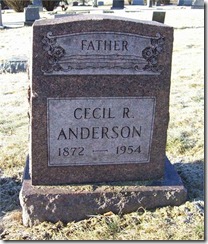
AcrHeadstone Slowly I read each letter of that carefully penned signature backwards.  And then I knew what the initials were in the note placed in the Bible Granddad had given me years before.

With my eyes and heart glistened and graced by years of fine memories including the memory of that initialed note in a birthday Bible, I silently said goodbye.  

Goodbye to my Granddad.  And to my Grandmother.  

If ever a  man was blessed by his grandparents, it was I.

Note: This story was first published as part of an English paper at Florida State University in 1957. At that time, I was still in possession of Granddad’s original poem. The professor liked the story and poem so much that he read both to the class.